Pandava army
Bhagavad GitaThe Pandava army is the force of the Pandavas assembled on the sacred plain of Kurukshetra for the impending battle against the Kaurava army. It is presented as both a powerful military formation and a network of family, teacher, friendship, and political allegiance. Its strength creates the immediate conditions for battle, while its closeness to the opposing army turns a public war into a crisis of conscience for Arjuna.
Formation and Command
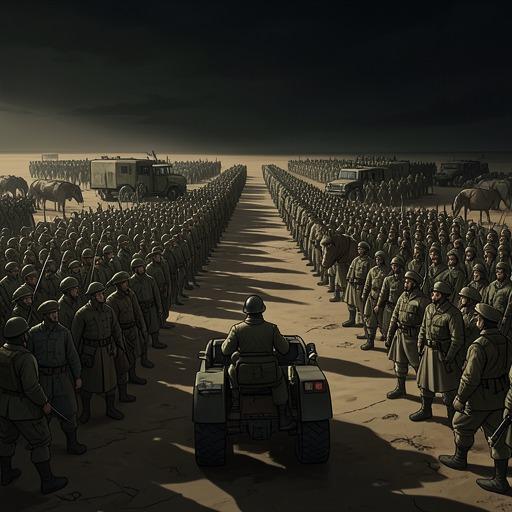
The Pandava army is already arrayed when Duryodhana approaches Drona and calls attention to its vastness. He identifies Dhrishtadyumna, Drupada's son and Drona's intelligent disciple, as the commander who has arranged the formation. The remark makes the army's organization politically and emotionally charged: the man directing the Pandava forces is connected both to the opposing king Drupada and to Drona, the preceptor whom Duryodhana is addressing.
Duryodhana describes the army as containing many brave and mighty bowmen, warriors whose battlefield power is comparable to that of Bhima and Arjuna. Among those named are Yuyudhana, Virata, Drupada, Dhrishtaketu, Chekitana, the ruler of Kasi, Purujit, Kuntibhoja, Saivya, Yudhamanyu, Uttamaujas, Subhadra's son, and the sons of Draupadi. The list gives the force breadth as well as weight: it includes rulers, renowned bowmen, mighty car-warriors, younger heirs, and allied champions rather than a single household fighting alone.
Warriors and Military Contrast
The Pandava army is explicitly contrasted with the Kaurava army. Duryodhana says that the Pandava force is protected by Bhima and calls it sufficient, whereas he describes his own army, protected by Bhishma, as insufficient. Whether this judgment expresses strategic anxiety, rhetorical manipulation, or both, it establishes the Pandava army as the formation that the Kaurava side must contain rather than dismiss.
The army's force is made audible through the ceremonial and martial sound of the conches, drums, cymbals, and horns. Bhishma begins the uproar with a lion-like roar and the blowing of his conch, after which the assembled forces answer. From the Pandava side, Krishna and Arjuna, standing together on a great chariot yoked to white steeds, blow their celestial conches. Krishna's Panchajanya and Arjuna's Devadatta are joined by Bhima's Paundra, Yudhishthira's Anantavijaya, Nakula's Sughosa, and Sahadeva's Manipushpaka. The ruler of Kasi, Shikhandin, Dhrishtadyumna, Virata, Satyaki, Drupada, Draupadi's sons, and Subhadra's son also sound their conches. The reverberation fills the sky and earth and strikes the hearts of the Kaurava troops, making the army's unity a physical presence before weapons are fully engaged.
The Army as a Kinship Network
The Pandava army is not simply an aggregate of combatants. Its members are bound to one another and to the opposing force through dense ties of descent, marriage, instruction, friendship, and political alliance. The names of Drupada, Dhrishtadyumna, Draupadi's sons, Subhadra's son, and the Pandava brothers place several generations and allied houses within the same battle line. The army therefore represents a collective family and coalition whose military purpose cannot be separated from the relationships that produced it.
That structure becomes decisive when Arjuna asks Krishna to place their chariot between the two armies so that he can observe those assembled to fight. Krishna positions the chariot before Bhishma, Drona, and the kings of the earth. From there Arjuna sees elders, grandfathers, fathers-in-law, sons, grandsons, maternal uncles, brothers-in-law, friends, teachers, and well-wishers standing on both sides. The Pandava army thus becomes one half of a divided social body: its members are ready to fight, but the identities visible across the field make the boundary between ally and enemy morally unstable.
Arjuna's Crisis Before Battle
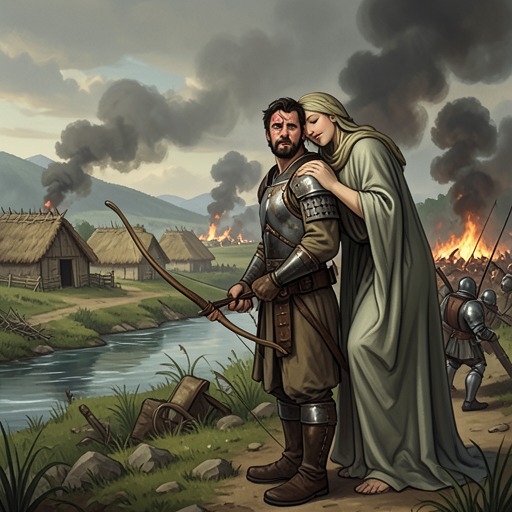
The army's presence precipitates Arjuna's grief. As he looks upon the assembled kinsmen, his limbs weaken, his mouth dries, his body trembles, and his hair stands on end. Gandiva slips from his hand, his skin burns, and he says that he can no longer stand. These physical signs transform the Pandava army from a symbol of strength into the scene of an embodied moral collapse.
Arjuna rejects victory, sovereignty, pleasure, and even life when those gains would be purchased through the deaths of the people for whose sake they are desired. He names preceptors, sires, sons, grandsires, maternal uncles, fathers-in-law, grandsons, brothers-in-law, and kinsmen among those prepared to die. Even if the opposing warriors attack him, he does not wish to kill them, not even for sovereignty over the three worlds. The army's very composition therefore supplies the reason for his refusal: the war is not against strangers but against the relationships that give political triumph its meaning.
Arjuna extends the objection beyond personal grief to social consequence. He fears that killing kinsmen will destroy the customs of a race, allow sin to overpower the surviving community, corrupt its women, produce an intermingling of castes, interrupt ancestral rites, and lead both the destroyers and the destroyed race toward hell. In this argument, the Pandava army is the potential instrument of victory and the potential agent of social dissolution at once. Arjuna finally declares that it would be better to be killed unresisting and unarmed than to slay his own kinsmen for the sweets of sovereignty.
Duty, Cosmic Agency, and Narrative Significance
Krishna's teaching recasts the army's meaning. Arjuna is told that the embodied soul is immortal, that bodies are cast off like worn garments, and that death and rebirth belong to an unavoidable order. He is also reminded that a fair battle is the prescribed duty of a Kshatriya and that abandoning such a battle would bring sin, loss of fame, and the judgment that he had fled from fear. The Pandava army thus becomes the setting in which private compassion is placed against duty, reputation, social order, and the distinction between the eternal soul and the perishing body.
Krishna's later revelation of the Vishvarupa gives the army an even larger significance. In the cosmic vision, the sons of Dhritarashtra, Bhishma, Drona, Karna, and other warriors rush into the terrible mouths of the divine form. Krishna declares himself to be Death, the destroyer of worlds, and tells Arjuna that the warriors have already been slain by him; Arjuna is to act only as the instrument. The Pandava army is consequently absorbed into a cosmic process that exceeds the intentions of both sides. Its military action remains real, but its outcome is presented as already encompassed within divine destruction.
The army also belongs to a wider teaching about action and order. Work performed for sacrifice does not bind, while action driven by attachment does; one must perform the duty appropriate to one's nature without clinging to its fruit. The duties of the Kshatriya include bravery, energy, firmness, skill, refusal to flee from battle, liberality, and the bearing of a ruler. Against this doctrinal background, the Pandava army is the institutional field in which Arjuna's own duty becomes unavoidable. Its significance lies not merely in whether it defeats the Kaurava army, but in how its existence forces the text to ask whether righteous action can remain righteous when its immediate objects are beloved relatives and teachers.